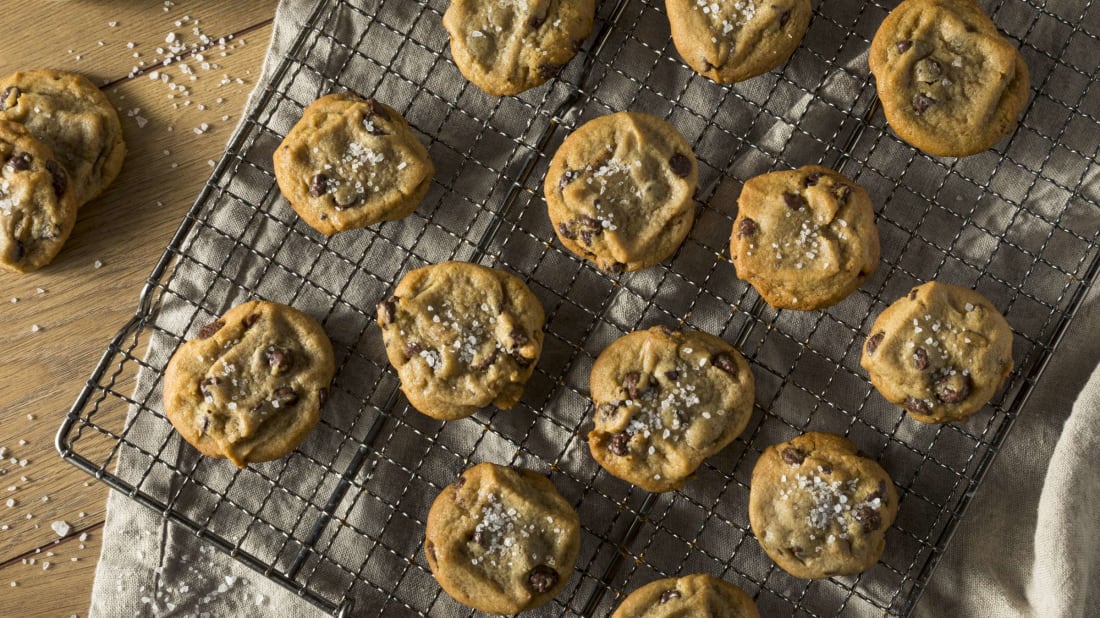
Chef Tracy Wilk has made a lot of chocolate chip cookies in her day. This recipe, which she taught us at the Institute of Culinary Education, is her go-to. It balances savory and sweet and creates an addictive chocolate chip cookie that has some surprises in store (like a mix of white, dark, and milk chocolate).
Sea Salt Chocolate Chip Cookie Recipe
Makes 24 cookies
Ingredients:
235 grams (1 ¾ cups) all-purpose flour
3 grams (½ teaspoon) baking soda
2 grams (½ teaspoon) fine sea salt
170 grams (6 ounces) butter, room temperature
165 grams (¾ cup) light brown sugar
110 grams (½ cup) granulated sugar
1 large egg
1 large egg yolk
4 grams (1 teaspoon) vanilla extract
300 grams (2 cups) chocolate (mix of white, dark, and milk), chopped
Maldon sea salt, as desired for sprinkling on top of cookies
Instructions
1. Preheat oven to 325°F.
2. Place flour, baking soda, and salt in a bowl. Whisk together and set aside.
3. In a stand mixer fitted with a paddle, cream together the butter and sugar. You want to mix on medium speed until the butter is fluffy. This will take about 5-10 minutes, depending on the temperature of the butter.
4. Once the butter and sugar is creamed, turn the speed to low. Crack your eggs into the container, and add your eggs and vanilla. Mix for about 30 seconds, just until combined.
5. Turn the stand mixer off and add your dry ingredients. Mix on slow speed until about three-quarters of the way combined. Turn machine off and add chopped chocolate, and mix on slow speed until the mixture just comes together.
6. Using a 1 ½ ounce ice cream scoop, divide the dough into 24 equal balls, pressing the palm of your hand against the scoop for a flat surface. Place cookie dough balls on a full sheet tray that has been lined with parchment paper and allow the dough to chill for at least 30 minutes.
7. Sprinkle the top of each cookie with a pinch of Maldon sea salt.
8. Bake until cookies are golden brown, about 8-10 minutes. Allow to cool for at least 5 minutes before removing from sheet tray.
How to Substitute Cookie Ingredients
Chef Wilk used the recipe as a starting point to teach a lesson on the chemistry of cookies. Here are a few substitutions she experimented with, and the way they affect the final product.
Chocolate chips: Chef Wilk's recipe calls for high-quality couverture chocolate, which melts into a gooey final product. Commonly available chocolate discs have a similar effect. Chocolate chips have a lower cocoa butter content, which means they don’t melt at the temperature used in the recipe. Use chips if you prefer a less gooey cookie.
Melted butter: Using melted butter, rather than the recipe’s softened butter, allows less air to enter the cookie dough during the “creaming” stage. This creates a cookie with less rise and a bit of extra crispiness, along with a slightly nuttier flavor that some find appealing.
Brown sugar: Brown sugar has molasses, so a recipe that subs out all the white sugar for brown has a more distinct molasses taste. Because brown sugar is more acidic, it also activates the baking soda a bit more, creating a slightly puffier cookie.
White sugar: Conversely, subbing out all the brown sugar for white activates less baking soda. The result is a cookie that rises less and spreads more. It also lacks a certain depth of flavor that the brown sugar provides.
Baking powder: By subbing out baking soda for baking powder, the cookie puffed up a bit more in the middle, but had a less uniform rise.
Gluten free: Using gluten-free flour created a predictably less chewy cookie (because one of the defining characteristics of gluten is the chewiness it imparts in the presence of water). It also had less structure, and was more apt to crumble rather than breaking apart.
Vegan: Chef Wilk also tried an entirely vegan “healthy” cookie, swapping in canola oil for the butter, vegan dark chocolate for the chocolate combination, coconut sugar for brown sugar, and whole wheat flour instead of all-purpose. As Chef Wilk admitted herself, there may well be a delicious vegan cookie recipe out there, but this isn’t it!

With roughly 7500 craft beer breweries in the United States—a number that continues to grow—it’s clear consumers like their ales and lagers. And as more of these breweries pop up in towns and cities every month, it’s up to brewmasters to constantly produce new beers to satisfy demanding (and evolving) palates, maintain a sterile workspace, and properly operate all the complex machinery that pumps out your favorite IPA. To find out what goes into owning and operating a brewery, Mental Floss spoke with a number of brewmasters about what their days entail. Here’s what they had to say about taste tests, oyster beer, and getting doused in hop sludge.
1. A lot of brewmasters started out as home brewers.
While brewmasters sometimes attend college to study chemistry or even specific brewing courses, a fair number get their start in their own homes. “When I started, I would say about 50 percent [were home brewers],” Tom Kehoe, co-owner of Yards Brewing Company in Philadelphia, Pennsylvania, says. This was back when there were only around 649 breweries in the country, according to Kehoe. That number has only grown with time, and now he says as many as 90 percent of current brewers experimented with home brewing before moving on to larger productions.
While home brewing can be a good start, Kehoe says that there’s a limit to how much you can learn in a garage setting. “The basic knowledge of how beer is made is exactly the same. However, good brewing practices need to be learned on site. The environment working in a brewery is a lot different than brewing at home.”
One example? Size. According to Jeremy Moynier, brewmaster of Stone Brewing in San Diego, California, people are surprised when they see the scale of some brewing operations. "A home brewer is used to making a few gallons," Moynier says. "We could be making a 250-barrel batch [at Stone]. Each barrel is 30 gallons."
2. Brewmasters use sound almost as much as taste to evaluate the brewing process.
Breweries come in all shapes and sizes, but all of them implement a lot of machinery, stainless steel vats, pumps, and bottling lines to concoct their brews. It becomes a symphony of sorts, according Moynier. And if one instrument sounds off, he can tell.
"You use all of your senses, from taste to sound," he tells Mental Floss. "Breweries are noisy, and there are sounds you get attuned to. If something sounds wrong, you know there’s a problem somewhere. Your senses being in tune are important."
Once, Moynier heard an unusual squeaking noise in the factory. He discovered that the tank that held the crushed malt was backed up, which would eventually ruin the conveyor belts if no one noticed in time. Thankfully, Moynier picked up on that change in noise, and the problem was corrected before the machine required a more expensive repair.
3. Brewmasters are always trying novel flavors. Even oysters.
There’s no shortage of creativity among brewmasters, with breweries constantly experimenting with different flavor profiles, from tea to chocolate to fruit. "There are so many different styles, flavor, and aroma profiles you can hit," Moynier says. "We’re constantly learning about new ingredients.” One that impressed Moynier recently was an oyster stout, a style that was originally billed as a beer that simply paired well with oysters more than a century ago, but has since evolved to include actual oyster meat and stock in modern recipes. This one came from Liberty Station, one of Stone Brewing’s locations in San Diego. "It was pretty fascinating," he says. "They got a real briny, oyster thing going."
4. Sanitation is one of the most important parts of being a brewmaster.
The stereotype of brewmasters sipping beer all day and hovering over batches is slightly misguided. According to John Trogner, co-owner with brother Chris of Tröegs Independent Brewing in Hershey, Pennsylvania, most of the job is making sure beer is made in clean conditions. “People usually think you’re sitting around all day dreaming up recipes and tasting beer,” Trogner says. "That’s a very small component. Physical cleaning is probably 80 percent of it. Sanitation is paramount. It’s like a chef keeping a kitchen clean. Workers spend most of their time scrubbing."
Just because the breweries are kept clean doesn't mean the brewmasters are quite as lucky. Depending on the valve and your luck that day, that could sometimes mean an unintentional beer shower for workers. "I’ve taken baths in yeast and beer sludge," Trogner says of his early days, explaining it's a hazard you face when you're opening the valves on the brew tanks.
5. Brewmasters know they're expected to bring beer to most gatherings.
Like any other profession, brewmasters can sometimes be greeted with an expectation that their services and goods are free for friends and relatives to enjoy at gatherings and family events. "If it’s appropriate to bring beer, I will," Kehoe says. "And sometimes when it is not so appropriate. I have brought beer to a business networking breakfast and somehow it turned out to be a great icebreaker. I find that people are disappointed if I don’t have at least some beer at the ready."
6. The job can make you critical of other beers and even food.
Working to perfect beers all day can have an effect on how brewmasters regard other beer options. "I still love beer, but it changes the way you approach it," Moynier says. "You pick out a flaw, and it will bother you. It might ruin your enjoyment. But if you find a beer you really like, it can also make it more enjoyable."
A brewmaster doesn’t just develop a sense of what makes for a good beer; they’re also constantly thinking about what type of food pairs well with certain beers. "It definitely affects the way you taste things," Moynier says. "It’s made me a pickier eater. You’ll think about how food will pair with beer sometimes, where you wouldn’t necessarily think about that before. It made me appreciate how things go together."
7. Brewmasters know names and logos can make or break a beer.
With so many beer options, it’s imperative for brewmasters to use marketing as a way of setting up a consumer’s palate before they sample anything. For Tröegs's Haze Charmer, which offers pineapple and grapefruit notes, the brewery went to great lengths to describe how the "haze" of the recipe carries hop oil into the mouth.
"Haze Charmer emerges from a soft, swirling cloud of oats and unmalted wheat. Vigorous dry-hopping adds a second phase of haze, propping up the oils of Citrus and El Dorado," the website description of the beer reads.
"The name is a critical component," Trogner says. "Consumers are getting to know it before they try it."
The right—or wrong—name and design can make all the difference. Trogner promoted a cherry, honey, and chocolate ale around the holidays and called it Mad Elf, with bottles and packaging decked out in cartoon images of a tipsy elf enjoying one too many. It's become a perennial hit.
"It’s a celebration of the holidays," Trogner says. "Mad Elf is kind of part of social webbing, which is nice to hear. Grandmothers come in and buy five or six cases for family coming over for the holidays."
Similar beers with different branding didn't fare as well. "We’ve done beers like Mad Elf out of season and it didn’t have near the fervor or excitement," he says.
8. A brewmaster associates a beer’s personality with color.
According to Kehoe, light and dark beers each give off a distinctive personality trait depending on their color, which comes from the grains used. "To me, the color of the beer is the mood of the beer," he says. "Light color is fluid and exciting; darker [is] slower and more filling and relaxing." Amber is more middle-of-the-road and more versatile. "[It] can be whatever personality that you want to project in the moment."
9. Smells are a big inspiration for new beers.
Don’t think brewmasters develop recipes based just on tasting other beers; it’s more of a multi-sensory experience. Trogner says that most beer ideas come from everyday life. “We’re not sitting around and looking at other types of beer,” he says. “It’s more about an experience, like having an amazing dish at a restaurant. Or you might be hiking and smell something floral in the air, like pine.”
10. Yes, brewmasters sometimes drink early in the morning.
While downing beer is probably not as common an occurrence as you might think, brewmasters are still expected to sample their wares before it goes out for distribution. According to Moynier, those executive samples can happen at odd times of the day depending on schedules.
"Tastings can happen at six in the morning," he says. "We also have structured tasting and daily taste panels to approve beer about to be packaged. Three times a week we have a brewmaster taste panel where we focus on new beers we’re trying out for release or changes to recipes. There’s an executive panel once a month with [Stone's founders Greg Koch and Steve Wagner]."
Or, as Kehoe puts it, “I don’t drink all day, but I do drink every day.”
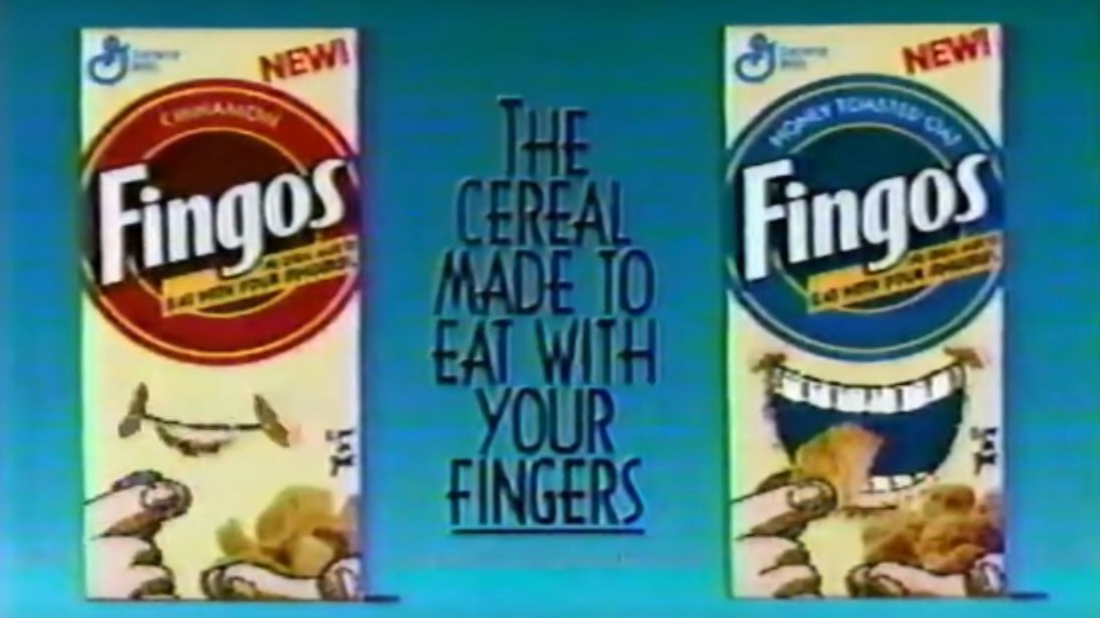
For practically as long as dry, ready-to-eat breakfast cereals have existed, people have been eating them out of the box or using them in alternative recipes like Rice Krispies Treats.
The problem was that not enough people were reaching for cereal at other hours of the day. According to research conducted by General Mills in the early 1990s, only 7 percent of those who purchased cereal ate it outside of the breakfast window. The company believed that if more consumers could be persuaded to snack on cereal throughout the day, then maybe General Mills could finally outpace the Kellogg Company as the most dominant cereal manufacturer on the market.
After years of research and development, General Mills introduced their secret weapon in 1993. It was called Fingos, a hexagon-shaped cereal that consumers were encouraged to eat with their hands.
The snack vs. cereal conundrum
Superficially, there was little about Fingos that made it any more of a snack than a cereal. The irregularly-shaped pieces—available in either a toasted honey nut or cinnamon flavor—had roughly the same nutritional and ingredient profile of typical lightly-sweetened cereals. Slightly larger than a corn flake but smaller than a potato chip, Fingos could wind up in milk just as easily as any other kind of cereal. The difference was that General Mills wanted buyers to eat it dry.
It was a “cereal made to eat with your fingers,” according to ad copy, part of a campaign that cost General Mills $34 million—making it one of the largest promotions ever for a cereal launch.
“We’re breaking the traditional bounds of advertising cereal because we’re trying to break the bounds of how people use cereal,” Barry Davis, then the marketing manager for General Mills’ Big G cereals, told The New York Times.
In pushing Fingos as a dry snack, the hope was that it could surmount a market trend of consumers skipping breakfast or opting for healthier foods like yogurt. General Mills felt that giving consumers permission to dive into the box the other 23-odd hours of the day would help offset early-morning avoidance of cereals.
invading the snack market
While breakfast may have been a problematic market, it was still a lucrative one. At the time, the dry cereal industry was worth $8 billion annually, with more than 210 cereals on shelves vying for the attention of 97 out of 100 households who purchased boxes for their pantries. If a new product could capture just 1 percent of that market share, it would still be an $80 million success story and likely enough to vault General Mills and its 29.5 market share over Kellogg, which owned 37 percent.
To increase the chances of Fingos taking off, General Mills designed a package that was wider on top to accommodate hands reaching inside. They also sold Fingos in single-serving packs in vending machines, a snack space typically reserved for potato chips and the like. The box itself featured a wide and smiling face that was animated for commercials, with voice actor Steve Mackall channeling Robin Williams as the Genie in 1992’s Aladdin.
“How wholesome am I?” the Fingos “spokes-box” asked. “Read my hips,” it said, aggressively shoving its nutritional information out at the viewer.
While Fingos was a modest 110 calories and 3 grams of fat per 1-ounce serving, General Mills opted not to market it as a healthy snack, as the market was already glutted with them. Instead, they felt the snack-cereal hybrid approach made Fingos stand out. In focus group testing, it seemed to work, too. Just 1 percent of respondents decided to pair it with milk.
Got milk?
But focus testing is one thing. The real world is another. When Fingos rolled out nationally beginning in the spring of 1993, consumers didn’t know what to make of it. If it was a snack, shouldn’t it have been located in the snack aisle? If it was a cereal, why try to compare it to chips?
Perhaps the most problematic component of Fingos was that consumers didn’t need permission to eat cereal dry and directly out of the box. That urge existed for practically every kind of cereal. Downplaying the appeal of Fingos in milk didn’t make it any more attractive as a snack.
Fingos bombed, eating its $34 million marketing budget whole and leaving only crumbs for General Mills, which had more or less abandoned the product by 1994. Fortunately, they had something else in the pipeline: Reese’s Peanut Butter Puffs, a hit that still sells to this day under the shortened name of Reese's Puffs.
Fingos, incidentally, had an unfortunate translation when uttered in Hungarian. Fing means fart, lending the snack the label of farto should it ever be sold in that country.
"ingredients" - Google News
March 14, 2020 at 04:30AM
https://ift.tt/2vkCgjX
Chocolate Chip Cookie Recipe and Ingredient Substitutions - Mental Floss
"ingredients" - Google News
https://ift.tt/2Qstat1
Shoes Man Tutorial
Pos News Update
Meme Update
Korean Entertainment News
Japan News Update
Bagikan Berita Ini


0 Response to "Chocolate Chip Cookie Recipe and Ingredient Substitutions - Mental Floss"
Post a Comment